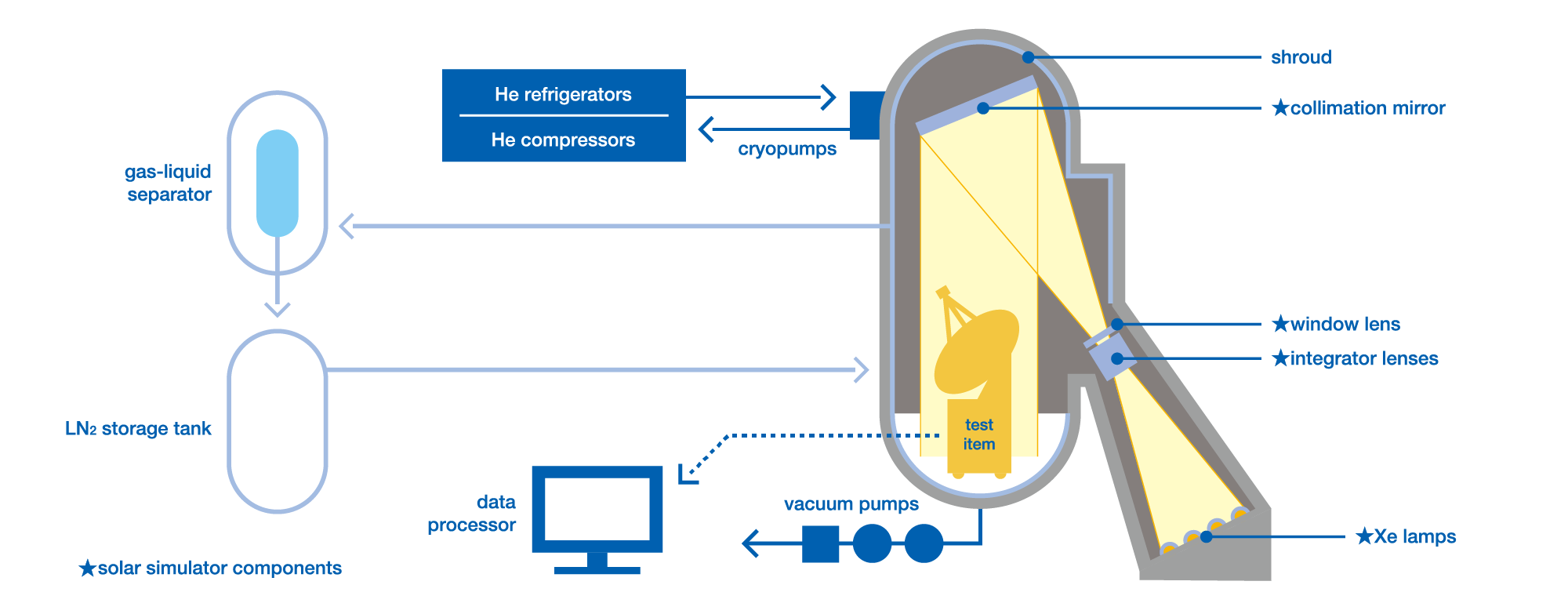
The 8mφ space chamber is used to simulate environments to which a spacecraft is exposed in space, such as high vacuum, cryogenic temperature, and high temperature due to the intense heat from the sun, for the purposes of verifying the endurance, function, and temperature profile of a test item. It can store a test item of up to 5.4 m in width and 5 m in height, which allows testing of small to middle-sized spacecraft or equipment to be loaded on a spacecraft.
It simulates the high vacuum and cryogenic environments in space respectively with vacuum pumps and shrouds covering the walls of the facility through which LN2 circulates.
This facility is equipped with a solar simulator, which is a system that simulates solar light heat with Xe lamps whose spectrum properties are similar to those of the sun, reflects them on a collimation mirror to make them parallel, and casts them upon a test item. Its ability to emulate solar light enables thermal tests in space-like environments. The facility is also capable of heating a test item with IR heaters.
The 8mφ space chamber, which began operation in 1975 and has long supported Japan’s space development, ended operation in 2025 because of deterioration over time.